1. Why an AI-Arbitrage Forecast Matters
Between 2024 and 2030, two forces are expected to shape digital finance more than any other: accelerated adoption of artificial intelligence in trading systems and continued expansion of cryptocurrency market infrastructure across centralized and decentralized venues. AI Arbitrage sits directly at this intersection, which makes it useful as a case study for forecasting how AI-enabled arbitrage models may perform in the next market phase.
A proper forecast is not about “will it moon.” It is about structural conditions: fragmentation, volatility, competition, and regulation. Arbitrage survives when markets remain inefficient enough for spreads to exist, and when execution systems are sufficiently advanced to capture them.
2. Market Baseline in 2024–2025
Crypto markets in 2024–2025 display three baseline characteristics that support arbitrage:
First, exchange fragmentation is persistent. Even if large global exchanges dominate volume, liquidity is still distributed across multiple centralized exchanges, regional exchanges, and decentralized exchanges. There is no unified order book.
Second, volatility remains structurally higher than in most traditional asset classes. That volatility creates short-lived inefficiencies where order books do not update synchronously across venues.
Third, retail demand for automation has risen. Many participants prefer systems that reduce manual decision-making. This does not guarantee performance, but it increases adoption potential for tools positioned as automated.
AI Arbitrage operates in this baseline environment, where spreads may often exist in the 0.2% to 1.5% range depending on liquidity conditions, time of day, and volatility. After fees and slippage, realistic net margins may compress to roughly 0.1% to 0.6% per executed cycle, depending on execution quality.
3. Key Trends Shaping AI Arbitrage by 2030
Trend A: AI penetration in trading infrastructure accelerates
By 2030, a large share of trading operations in both traditional finance and crypto markets is expected to be AI-assisted. The key shift is not that AI “predicts price,” but that AI increasingly optimizes operational processes: routing, timing, risk constraints, and signal validation. In arbitrage models, this operational AI is more relevant than predictive AI.
Trend B: Market efficiency increases, compressing spreads
As automation adoption grows, arbitrage gaps narrow. This is a predictable effect: inefficiencies attract capital, capital reduces inefficiencies. Between 2025 and 2030, average actionable spreads are likely to compress. If 2024 conditions allow 0.3%–0.8% net windows on many venues, the market may gradually move toward 0.1%–0.4% net windows for comparable conditions, assuming constant fee levels.
Trend C: Exchange structure remains mixed rather than unified
A full convergence into a single global liquidity pool is unlikely by 2030. Regulatory segmentation, regional exchanges, and the growth of DEX liquidity suggest fragmentation will remain. The difference is that fragmentation becomes more “efficient fragmentation,” with faster price convergence.
Trend D: Fees and settlement improve gradually
Exchange fees may decrease modestly as competition intensifies. Settlement infrastructure will improve, including better bridging and faster on-chain settlement. This trend can partially offset spread compression. If fees decline by even 10%–20% over the period, net margins can remain viable for optimized systems.
Trend E: Regulation becomes more structured
By 2030, major jurisdictions are expected to apply clearer frameworks to AI usage and digital asset trading. This may reduce uncertainty but increase compliance costs. For an arbitrage platform, compliance clarity can be positive if it stabilizes exchange operations.
4. Scenario Modeling to 2030
Forecasting AI Arbitrage outcomes depends on external market conditions and internal execution capability. Below are three scenarios with quantitative ranges designed to reflect realistic paths rather than extremes.
Scenario 1: Base Case (Most Probable)
In the base case, crypto markets remain fragmented, volatility persists, and AI adoption increases. Competition compresses spreads, but improvements in infrastructure and fees partially offset this.
Expected conditions by 2030 in this scenario:
-
Actionable net spreads: 0.1%–0.4% per cycle (average conditions)
-
Annualized opportunity environment: moderate, stable
-
Performance dispersion across platforms: high (execution quality becomes decisive)
In this case, AI Arbitrage remains viable if it continually upgrades infrastructure, improves slippage control, and maintains reliable exchange connectivity.
Scenario 2: High-Competition Efficiency Case
In this scenario, institutional and high-frequency systems expand aggressively into crypto arbitrage. Price convergence becomes extremely fast. Retail-accessible margins shrink, and execution becomes a technological arms race.
Expected conditions by 2030:
-
Actionable net spreads: 0.05%–0.25%
-
Higher reliance on ultra-low latency
-
Higher failure rate for non-optimized systems
Under this scenario, AI Arbitrage would need a strong technical edge to remain competitive. The platform could still operate, but the business model becomes more dependent on scale, precision, and fee optimization.
Scenario 3: High-Fragmentation Volatility Case
This scenario assumes higher volatility persists due to macroeconomic cycles and continued proliferation of exchanges and DEX liquidity pools. Fragmentation increases faster than efficiency improvements.
Expected conditions by 2030:
-
Actionable net spreads: 0.15%–0.6%
-
More frequent opportunities during volatility spikes
-
Strong upside for adaptive systems
In this scenario, AI Arbitrage would have an improved opportunity environment, but operational risk would also rise. Exchange outages and liquidity shocks become more frequent in high-volatility periods.
5. What Determines Survival for Platforms Like AI Arbitrage
Between now and 2030, the winners in AI-driven arbitrage will be determined by execution, not branding. A platform can survive spread compression if it maintains operational efficiency and reduces loss factors.
The core determinants are likely to be:
-
Latency management and order routing quality
-
Slippage control and depth-aware sizing
-
Fee optimization and exchange selection logic
-
Risk controls for partial fills and disruptions
-
Continuous AI calibration based on trade outcomes
By 2030, “AI” alone will not be a differentiator. Optimization will be expected.
6. Market Demand and Adoption Outlook
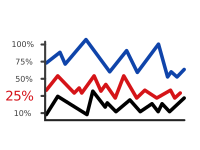
Retail and semi-professional demand for automated trading will likely grow. A reasonable projection is that the share of retail crypto participants using automation tools could rise from roughly 10%–20% today to 25%–40% by 2030, depending on regulation and platform accessibility.
This adoption trend supports platforms like AI Arbitrage even if margins compress. Revenue models may shift toward service access and performance-based structures rather than purely capital-driven yields.
7. Risks That Could Break the Forecast
The main forecast breakers are regulatory shocks, exchange consolidation, and systemic liquidity changes.
If a major region imposes restrictive rules on automated trading or reduces exchange availability, arbitrage access can decline. If exchanges consolidate into fewer venues, fragmentation decreases. If DEX infrastructure becomes dominant with near-instant price convergence, cross-venue spreads may change in nature.
These risks are not guaranteed, but they are material by 2030.
8. Conclusion: A 2030 Outlook for AI Arbitrage
AI Arbitrage operates in a market segment that is structurally real: price discrepancies across fragmented venues. That condition is unlikely to disappear fully by 2030. However, the next five years are likely to deliver increased efficiency, rising competition, and growing compliance complexity.
The platform’s long-term viability depends on continuous infrastructure upgrades and adaptive execution logic. In most reasonable scenarios, AI-driven arbitrage remains viable, but margins are expected to narrow, increasing the importance of technical execution quality.
Forecast Ratings (Non-Recommendation Opinion)
2030 Market Alignment: 8.5 / 10
Sustainability Under Base Case: 8 / 10
Resilience Under High-Competition Case: 7 / 10
Upside Under High-Volatility Case: 8.5 / 10
Overall Forecast Assessment: 8 / 10
AI Arbitrage is positioned in a segment with persistent structural demand. The primary variable through 2030 is not the concept, but execution capability under increasing competitive pressure.